
UK vs USA vs Australia for Post-Study Work 2027: the $70,000 OPT Fee Proposal vs the UK Graduate Route
Quick answer
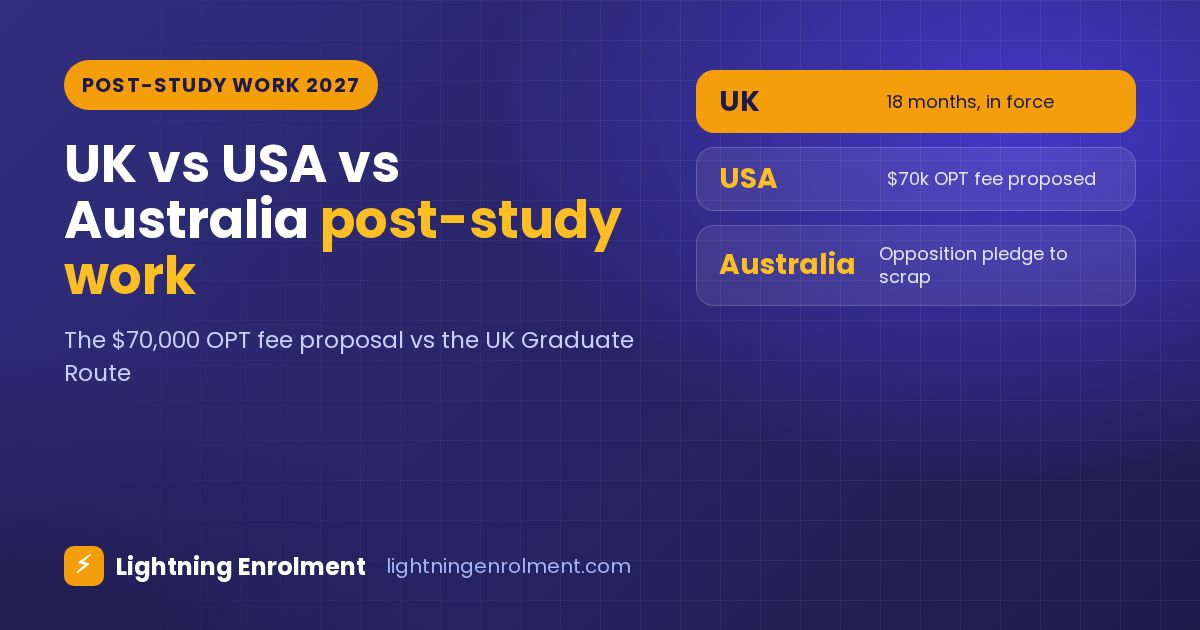
Post-study work is changing in the US and could change in Australia. The UK's Graduate Route is already set in law.
- UK: the Graduate Route is in force. Bachelor's and master's graduates currently get 2 years to work in the UK. For applications made on or after 1 January 2027, that becomes 18 months. PhD graduates still get 3 years.
- USA: on 7 October 2026, the US government proposed that universities pay $70,000 per student to recommend them for OPT (the US post-study work scheme), plus $30,000 for any further OPT period such as the STEM extension. This is a proposal, not law.
- Australia: the opposition Coalition has pledged to abolish Temporary Graduate visas for most students if it wins power. This is a campaign promise, not law.
Thinking about the UK? Check which UK universities you qualify for.
Side-by-side comparison (October 2026)
| UK | USA | Australia | |
|---|---|---|---|
| Post-study work route | Graduate Route | OPT (Optional Practical Training) | Temporary Graduate visa |
| Status today | In force | In force, but a $70,000 fee is proposed | In force, but the opposition pledges to abolish it |
| Length (bachelor's or master's) | 2 years, or 18 months for applications from 1 January 2027 | 12 months, plus a 24-month STEM extension | Depends on the qualification |
| PhD graduates | 3 years | Same OPT rules | Kept under the opposition's plan |
| Job offer needed? | No | No, but work must relate to your degree | No |
| What's uncertain | Little: the 18-month change is already in the rules | Whether the fee is finalised, and whether universities pass it on to students or employers | Depends on the next Australian election |
USA: the proposed $70,000 OPT fee
- What: a proposed rule, published on 8 October 2026, would make universities pay $70,000 before recommending a student for their first OPT period, and $30,000 for any later OPT period, including the STEM extension (Federal Register).
- Who pays: the university pays, but it may pass the cost on to students or employers.
- When: not yet. Public comments close on 9 November 2026. If the rule is finalised, it would take effect 60 days after the final rule is published.
- What it means: if it goes ahead, many universities may limit OPT recommendations or raise costs, which makes US post-study work far less certain.
Australia: Coalition pledge to scrap graduate visas
The opposition Coalition has pledged to abolish Temporary Graduate visas, keeping post-study visas only for PhD graduates, health and education students and those at regional universities. It has also pledged to cut new international students to 240,000 a year (The PIE News). Nothing changes unless it wins an election and passes the changes.
UK: what's actually happening with the Graduate Route
- The Graduate Route stays. You don't need a job offer or a sponsor to apply.
- The length is shorter from 2027. Applications made on or after 1 January 2027 get 18 months instead of 2 years (PhD: still 3 years). See Graduate Route 18 months from January 2027.
- Who gets 2 years: only graduates who finish their course and apply before 1 January 2027. If you start a UK course in 2027, you'll be on the 18-month rule. That's still longer than the US's standard 12-month OPT, and it's already confirmed rather than proposed.
Is the UK still worth it? By country
India
The UK is still one of the strongest options. Courses are short (one-year master's), the post-study work route is confirmed, and there's no OPT-style fee risk. Indian applicants do face more checks, so apply early with strong financial documents. See UK student visa refusal rate by country.
Nigeria
The UK route is stable, but refusal rates are high, and some universities have earlier deadlines or extra interviews for Nigerian applicants. Prepare carefully: funds held for 28 days, a credible study plan and the right course choice.
Pakistan
The UK is still possible, but some universities are restricting or pausing Pakistani applicants for January 2027. Choose a university that's actively recruiting. See which UK universities are restricting Pakistani applicants.
Saudi Arabia, Qatar, Kuwait, Oman, Bahrain and the UAE
Gulf students, many of them government-sponsored, benefit from reduced visa documents (except Saudi Arabia) and, if government-sponsored, can bring family. See government-sponsored Gulf students in the UK.
Get matched with a UK university
We check your eligibility, find universities that are recruiting from your country, and help with your application and visa. Our service is free for students.
Check my eligibility or apply for January 2027
Frequently asked questions
Is the $70,000 OPT fee in force?
No. It's a proposed rule published on 8 October 2026. Public comments close on 9 November 2026, and any final rule would take effect 60 days after publication.
Who would pay the US OPT fee?
The university would pay $70,000 per initial OPT recommendation and $30,000 for later periods, but it could pass the cost on to students or employers.
How long is the UK Graduate Route in 2027?
18 months for bachelor's and master's graduates who apply on or after 1 January 2027, and 3 years for PhD graduates.
Has Australia scrapped its post-study work visa?
No. The opposition Coalition has pledged to abolish most Temporary Graduate visas if elected, but the current rules are unchanged.
Is the UK better than the USA for post-study work?
For many students it's now more certain. The UK's route is confirmed in law and needs no job offer, while the US OPT fee proposal adds a large potential cost and uncertainty.